
Questions to ask before booking a venue in Atlanta


What craft services means on an Atlanta production set. Covers the crafty table, production meals, dietary needs, logistics, and what producers should expect.
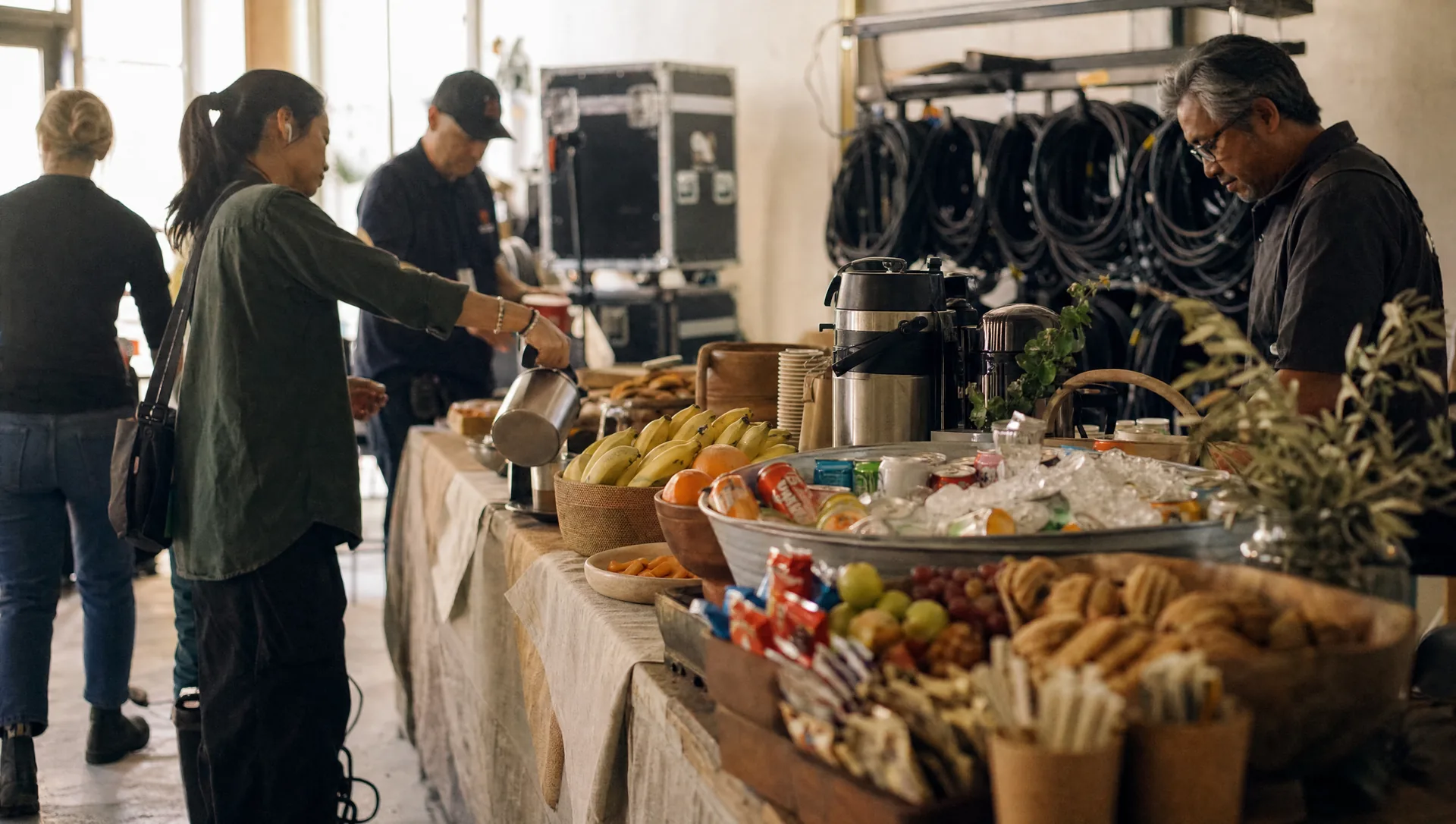
If you've never worked a production set, "craft services" sounds like it could mean anything. If you have, you know it means everything. Crafty is the fuel system that keeps a crew functional across 12, 14, sometimes 16-hour days. Get it right and nobody thinks about it. Get it wrong and it's the only thing people talk about.
Atlanta is one of the busiest production markets in the country. Between Trilith Studios, EUE/Screen Gems, Third Rail Studios, and the dozens of independent stages scattered across the metro, there are crews working every day of the week. And every one of those crews needs to eat. This is how craft services on an Atlanta set actually works.

New producers and production coordinators confuse these two functions constantly. They're separate operations with separate budgets, separate logistics, and often separate vendors.
Craft services (crafty) is the continuous snack and beverage station that runs from call time through wrap. It's always available. Crew members grab what they need between setups, during lighting changes, or on short breaks. Coffee, fruit, protein bars, snacks, and rotating hot items keep the table relevant all day.
Production meals are the full, scheduled sit-down (or stand-up) meals served at specific breaks. Union rules under SAG-AFTRA and IATSE require a hot meal within six hours of call time. Miss that window and you're paying meal penalties that compound by the quarter hour.
Both are essential. You cannot substitute one for the other. A crew running on crafty alone will burn out. A crew with great meals but no crafty will have dead energy between those meals. Budget for both as separate line items.
This is where craft services becomes a real discipline. Feeding a crew for a standard production day isn't about variety for its own sake. It's about energy management.
Early call (5 to 7 AM):
Mid-morning (9 to 11 AM):
Afternoon push (1 to 4 PM):
Evening grind (6 PM and beyond):
The table should look different at 3 PM than it did at 7 AM. A static spread is a lazy spread. Rotation shows the crew someone is paying attention. For the full breakdown of what belongs on the table, see what craft services includes on a film set.
A crew of 80 people will include vegans, vegetarians, gluten-free eaters, halal and kosher observers, nut allergies, and diabetics managing blood sugar. This is the reality of every Atlanta production. The craft services team needs to know about all of it before day one.
The call sheet should include dietary information. The craft services coordinator should review it, build accommodations into the main spread (not into a sad separate corner), and label everything clearly. A crew member with a nut allergy shouldn't have to interrogate the crafty person about every item on the table.
Building inclusive food into the main setup instead of segregating it is covered in depth in the feeding large crews on long shoot days guide.

Craft services is a food operation, and food operations have requirements. On a Trilith soundstage, conditions are different than on a location shoot in a Decatur warehouse or a Buckhead residential street. Here's what producers need to account for:
Not every caterer can handle a production set. The pace, hours, and expectations are different from a corporate event or a wedding reception. Here's what separates a set-ready provider from a general caterer:
Exquisite Delites brings production set experience across the Atlanta market. Chef Eric Centeno, trained under Master Chef Tom Chin, Gunter Seeger, Joel Antunes, and Wolfgang Puck, understands that set food is about sustaining performance, not just filling plates. Sandra, a former CNN and WSB-TV producer, knows what production days actually look like from the other side of the call sheet.
"On set, food is more than fuel. It's community. A hot soup at 2 a.m. or a perfectly timed smoothie shot can turn the whole vibe around." - Chef Eric Centeno
Rates depend on crew size, shoot length, location logistics, and the level of service. Most Atlanta providers quote on a per-person, per-day basis. Get quotes during pre-production so the number is locked into your budget before principal photography begins.
Yes. Some production caterers offer both under one contract, which simplifies coordination and can reduce costs. Others specialize in one or the other. If you use a single provider, make sure they have the staffing to run both operations simultaneously without either one suffering.
Underfunding it. When craft services gets cut to save budget, the crew feels it immediately. Low energy, longer setups, worse morale. The money you save on a cheap crafty table gets spent on overtime when the shoot day runs long because people are running on fumes.
If you're staffing up for a shoot in the Atlanta area, get in touch to talk through craft services, production meals, or both. We'll build a plan around your crew size, shoot schedule, and location requirements.
Their food is amazing! I mean absolutely top notch! This is the foodies caterer. The flavors were layered, the food was hot and fresh and the presentation was elevated. Don't question if it's the best option, Exquisite Delites should be your only option for a high touch catering experience.
Chef Eric is brilliant, innovative, and his food is just in a word delicious. He's creative and every time I try his food I'm amazed and blown away. Their company is incredibly professional and the service is spectacular.
The food was a delight and exquisite. They are very professional and diligent in what they do. I can really tell the passion in their food. Five out of five highly recommend.

